- HSM
- Shredding
- Other
- Information about data protection
- Legal
- Data protection in the home office
Protecting data - data protection in the home office
The fact that working in the home office is not only becoming more and more important in the current situation, but has already become part of a new work culture has been proven by statistics for quite some time. According to Statista, as early as 2019 almost 40 percent of employees were working entirely or partially from home. We can probably all imagine what the statistics look like in these extraordinary times, and many employees and the companies themselves are grateful for the opportunity to continue working in a protected work environment.

Rules for data protection in the home office
When it comes to handling particularly sensitive data in the home office, the same rules apply as when working with this data in the office. According to the General Data Protection Regulation (GDPR), the person dealing with the data is responsible for implementing suitable technical and administrative measures to ensure that personal data are handled in accordance with the data protection regulations. The employer is still responsible for staff who are working in a home office and must ensure that data protection measures are also implemented there and that the data cannot be accessed by unauthorised third parties.
However, this is particularly difficult in the home office, as contact with unauthorised persons outside the company is part of everyday life, making it difficult to protect sensitive data. This is particularly true if the home office workstation is not located in a separate, lockable room, but is perhaps in the living room or at the kitchen table. It is therefore especially important in the home office to destroy and dispose of sensitive data in a professional manner and in accordance with data protection regulations - by using a document shredder. When purchasing such a shredder, it must be taken into account what kind of data, in what form (on paper, data carriers, storage media, etc.) and what amount has to be destroyed in the home office.
Depending on this, different shredder models are suitable for meeting the data protection requirements in the home office.
Learn more about the different models of shredders for the home office on our website Shred @Home or find the right shredder for your needs configurator .
What are the risks and advantages of the home office?
The advantages of a home office/workstation at home are obvious. The employee no longer has to travel to and from the office, thus saving time and costs. The productivity level increases, since there is no distraction from other colleagues or from the general hubbub in an open-plan office. The home office therefore promotes concentrated and productive working..
However, working from home also brings some risks with it. In particular with regard to data protection and data security. The rules and regulations of the GDPR are still valid in the home office where personal data are concerned.
Who is responsible? Who is liable and when?
When the subject of data processing and data protection in the home office arises, the question of responsibility comes up again and again. Who is responsible for what and who is liable in the case of a claim? The GDPR is really quite clear about who is responsible for how personal data are handled. The responsibility lies with the person who determines the purpose of the data processing and how the data are processed. In an employment relationship, this is the employer. The employer is therefore responsible. The same applies to the liability. Since the employer, i.e. the company, is responsible for upholding data protection and data security, he/it is also liable. The employee has no external liability.

As an employer, how do I prepare for data protection in the home office? Which measures/precautions have to be taken?
The GDPR stipulates that the person/entity responsible has to take suitable technical and organizational measures to ensure that the data are handled in compliance with data protection requirements. This stipulation is also valid when the employee is performing his job in the home office - mobile working. It is important that the employee is also equipped with a GDPR compliant shredder in the home office so that data protection is ensured.
What must be observed regarding document shredding/data protection in the home office?
It must not be possible, at any time, for unauthorized third parties to see personal data. This is particularly important in the home office. Family members and relatives also count as unauthorized persons. In particular, if no separate and preferably lockable office is available at home, there is a particular danger that print-outs containing personal data can be viewed by others and this would therefore constitute a breach in the protection obligation for these documents.
How do personal data have to be processed in the home office?
Leaving documents lying around is not the only thing which contravenes the data protection regulations – incorrect disposal of the documents by putting them into the normal household rubbish opens up a big gap regarding data protection. The documents can namely be seen and read at any time by anybody and everybody. Tearing up the documents is also not data protection compliant, since it is child’s play to reconstruct the torn-up document.

What is the definition of "third parties"?
When it comes to data protection in the home office, it is essential to ensure that unauthorized third parties cannot access and view sensitive data at any time. In the home office in particular, the danger of third parties being able to view sensitive data increases. The definition includes all persons who do not belong to the company or who are not allowed to access sensitive data, which also means family members and relatives.
By using a shredder, it is also possible to prevent unauthorized third parties from gaining access to sensitive data in the home office and therefore to ensure data security.
If you want to learn more about data protection and shredding in your home office, please visit our Shred @Home webseite.
You can also find information on GDPR-compliant shredders on our GDPR-compliant shredders website.
How can I protect my employees / how can they protect the data from third parties?
To ensure that personal data and documents are protected and the protection obligation is upheld, the data and the documents must be destroyed in compliance with the GDPR. To this end, each employee who works with personal data in a home office or in a mobile capacity should be given a GDPR compliant document shredder.
Which document shredders are suitable for the home office?
For document shredders which are used in the home office, some of the requirements are understandably different to those for shredders used in a large open-plan office, for instance. This is, above all, the size requirement of the document shredder - but the noise level also plays an important role in the home office. The machine should be compact and require as little space as possible. A document shredder must also be as quiet as possible in the home office. The most important criterium which a document shredder in the home office has to fulfil is GDPR compliancy. It is vital for guaranteeing data protection in the home office.
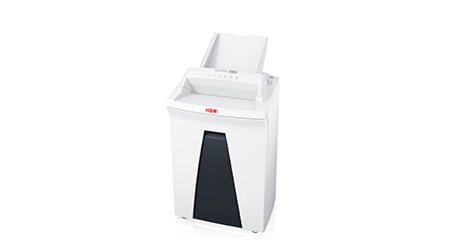
HSM has a wide range of document shredders which fulfil the particular requirements for the home office perfectly.
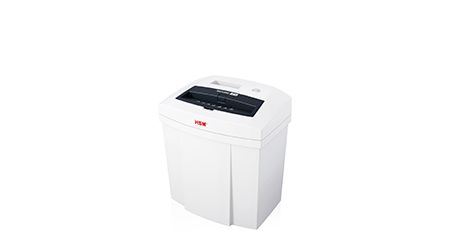

 20 l
20 l
 160 W
160 W