- HSM
- Compressing
- Other
- Baling press insights
- Properly tying bales

Tips for properly tying bales
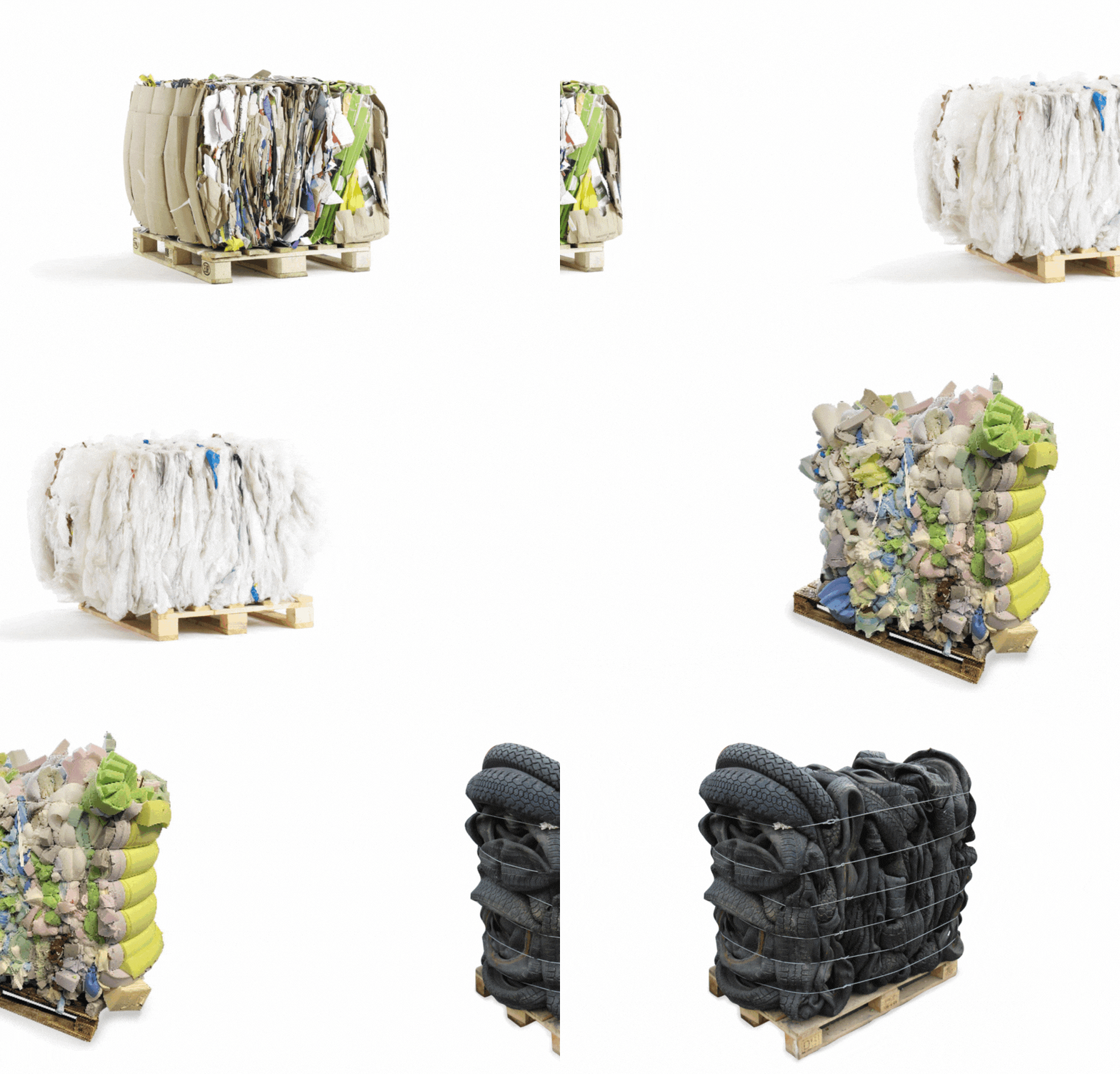
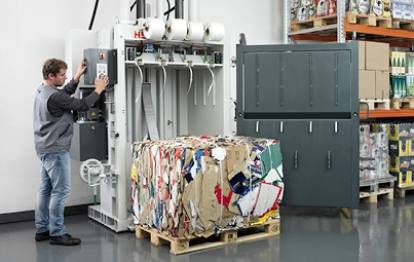
Balers compact production residues or waste. The tightly compressed bales can be stored in a space-saving manner and transported efficiently. This is achieved quickly and easily with a vertical or horizontal baler. Depending on the material, the original volume can be reduced by up to 95 percent through compression. Since the compacted material expands again after pressing, it must be held together with strapping tape or wire.
To ensure the compressed bale retains its shape, the material used should possess specific properties: it must be tear-resistant, grippy, and easy to knot. The tape material, supplied on a roll, ideally has a long overall length for extended use.
What are the different ways to secure a bale?
The technical term " binding" is derived from band. The so-called strapping band is supplied as an "endless band" on a roll – although it is not actually endless, it often reaches a length of up to 60 meters.
Cords, ribbons or yarn straps are available in various strengths: HSM uses WG 20, 30, 40, and 55 for strapping. The number in the product name indicates the tensile strength. Strapping with a higher number, such as WG 30, is stronger.
In practice, bales of waste cardboard weighing up to approximately 300 kg are usually tied with strapping. For this application, the relatively inexpensive strapping is perfectly adequate. Smaller bales are often delivered to local waste disposal companies, or waste collectors, who typically compress the delivered materials into larger bales of recyclable material.
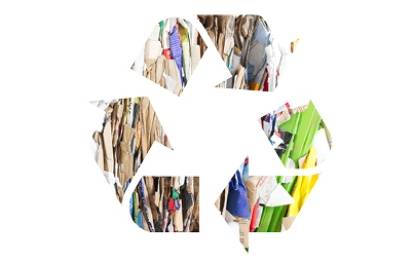
Depending on the disposal method and recycling process, wire strapping may be mandatory. Highly compacted, large bales of waste paper or cardboard weighing over 400 kg are generally strapped with wire . These waste paper bales are used for paper production. During paper processing, the bale is opened and the wire is separated from the recycled material.
Tape or wire – or both?
The material to be compressed is crucial for choosing the appropriate strapping.
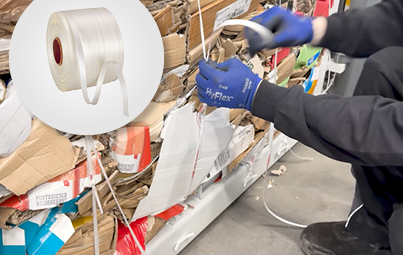
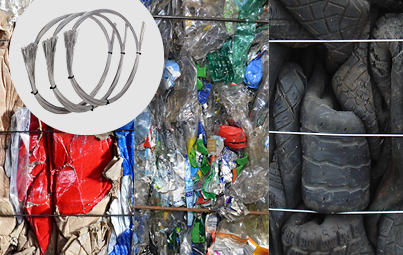
Many materials, such as foil, lightweight plastic containers, or textiles, are traditionally secured with strapping tape. The tape is knotted manually.
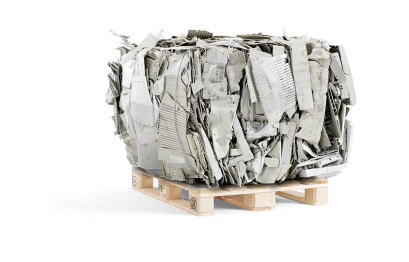
Paper scraps, die-cutting remnants, waste cardboard, and many other expansive materials require permanently stable strapping with wire once a certain pressure is applied.
The vertical balers from the mid-range and high-performance segment (HSM V-Press 830, HSM V-Press 860, HSM V-Press 1160) and other models are designed for wire feed as standard. HSM offers an optional strip feeder for many of these models. This allows for easy switching between wire and strip, or vice versa. This is practical and economical when processing different materials on a single press.
Wire is tear-resistant and universally applicable
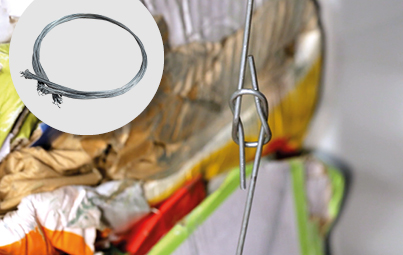
HSM uses wire for strapping bales weighing approximately 300 kg or more as standard. Loop wire is included with the high-performance HSM balers . This wire has one end formed as a loop. After baling, the loose end is pulled through the loop and twisted several times.
Waste paper and cardboard , empty or shredded PET bottles, hard plastic or expansive materials such as foam usually require binding with wire.
HSM V-Press 860 TimeSave and HSM V-Press 860 plus QL vertical baling presses as well as the HSM HL-series horizontal baling presses Quick-link wire is used. This consists of dimensionally stable spring steel and has pre-formed quick-release fasteners at both ends. This saves time and is particularly user-friendly. Quick-link wire is also significantly more tear-resistant than eyelet wire.
For the fully automatic channel baling presses of the HSM VK-series incidentally, several hundred meters of strapping wire rolls are used.