- HSM
- About us
- Other
- References
- Case Study: Hartmann



"Dream bales" for a perfect recycling material loop at PAUL HARTMANN AG
esterday, worthless waste was produced. Today PAUL HARTMANN AG produces marketable bales made of cardboard and polyethylene weighing 400 kilograms. The bales of used cardboard go to the cardboard supplier and thus reduce the costs for new packaging material. "A perfect recycling material loop", according to the person responsible at the manufacturer of medical devices. Key players in the success story: a horizontal baling press HSM HL 4812 and a vertical baling press HSM V-Press 860 S.
Company
PAUL HARTMANN AG is active across Europe as a spe- cialist in medical and hygienic products. The company has 11,000 employees and generates almost two billion euros in annual turnover.
Task
At the home site of PAUL HARTMANN AG in Heiden- heim, packages for end customers are assembled in the "Homecare" area and handed over to the dispatch department. This produces carton and polyethylene waste. This waste used to be thrown away. In the future, it is to be compressed and recycled.
Solution
PAUL HARTMANN AG chose a horizontal baling press HSM HL 4812 and a vertical baling press HSM V-Press 860 S. The horizontal press processes cardboard, the vertical one polyethylene.
Advantages
- Both machines can also be fed with the pressing material of the other machine
- Short service pathways
- Good support and advice in the decision-making phase
- Made in Germany
HSM V-Press 860 S:
- Bales weighing 400 kilos on a small floor space
- Special equipment sliding instead of side door
- Conversion from wire to polyester tape strapping presents no problems
HSM HL 4812:
- Special equipment tilting device and conveyor belt
- Advice with significant savings: semi automatic instead of fully automatic
- Manual wire strapping cost-effective and sufficient
- High bale quality allows good marketing
PAUL HARTMANN AG
10,000 employees worldwide, annual sales of almost two billion Euros – the HARTMANN Group is a provider of medical and hygienic products throughout Europe. The focal points are wound treatment, incontinence care and infection protection. PAUL HARTMANN AG in Heidenheim is the heart of the group of companies. It goes back to a textile factory founded in 1818 and is therefore one of the oldest German industrial enterprises. The company‘s homecare logistics are centralized in Heidenheim – the dispatch of small quantities to customers in Germany.
A lot of packaging material is produced in Heidenheim when goods are picked for orders: 260 tons of card- board and 60 tons of PE per year. Initially, this waste material was disposed of loose in 40-cubic meter containers, brought to an intermediary dealer and compressed there. The marketing revenues were modest. For Michael Kormann, Head of Homecare Logistics and Kornelia Bischof, Waste Management Officer, it soon became clear that the organisation of this process, which is both wasteful in transport and only produced modest results, could be improved. The obvious idea: in the future, HARTMANN wanted to compress the waste themselves in order to achieve proper revenues.
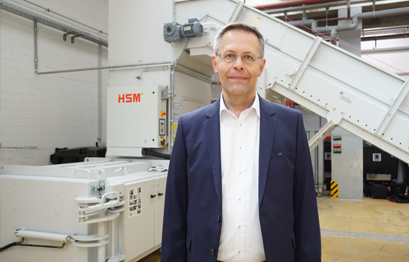
"The purchase price is only one aspect; for us the service also has to be right during the operating phase and the systems have to operate cost-efficiently in the long term. We considered HSM to be best placed to fulfil this."
Michael Kormann, Homecare Logistics Manager, PAUL HARTMANN AG
"The products make a very good impression"
Those responsible at HARTMANN looked at several suppliers of baling presses and also put a machine to the test. The problem: this press could only produce bales of up to 200 kilograms. "This was not enough for the paper factory," reports Kornelia Bischof. The pilot operation was terminated. After a longer selection process, Michael Kormann and Kornelia Bischof decided on presses from HSM. "The products make a very good impression," reports Michael Kormann. Operability, soundness, high reliability and thus low maintenance costs with a long service life were the decisive factors in choosing the baling presses from the medium-sized company from Lake Constance. Those responsible at HARTMANN also had confidence that the service pathways were short at HSM. Michael Kormann: "The purchase price is only one aspect, for us the service also has to be right during the operating phase and the systems have to operate cost-efficiently in the long term. We considered HSM to be best placed to fulfil this."
The V-Press 860 S in action
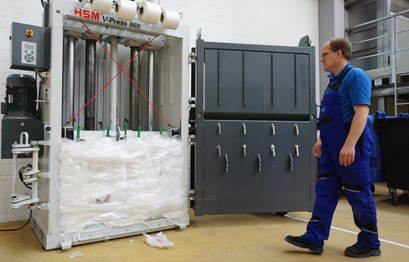
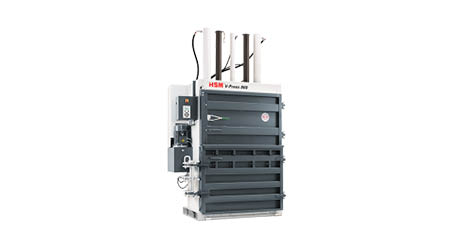
At the beginning of the new era in the waste recycling of Homecare Logistics, the vertical baler HSM V-Press 860 S was used for the compressing of polyethylene films into the smallest space. This machine was selected for the trial phase at PAUL HARTMANN AG. In collaboration with the HSM Sales team, this vertical baling press was adapted to the requirements of HARTMANN: it was provided with – for HSM a first – a sliding door – instead of the sideways opening door provided as standard. The persons responsible at HARTMANN also liked an unique feature of the vertical machine: the compressing process starts automatically when the door is closed and the door opens automatically after the end of the compressi- on. Moreover, since the customer receiving the PE bales from PAUL HARTMANN AG did not want any wire strapping, the HSM V-Press 860 S was equipped with polyester strapping for the first time. Additional effect: seventy-five percent lower costs for strapping material. Michael Kormann: "The machine was adapted to our needs and the innovations worked well." The result of the test was therefore positive. The HSM V-Press 860 S is compact, requires little floor space and produces easily marketable bales weighing around 400 kilograms, although loose PE films are fed in, which is praised by Kormann.
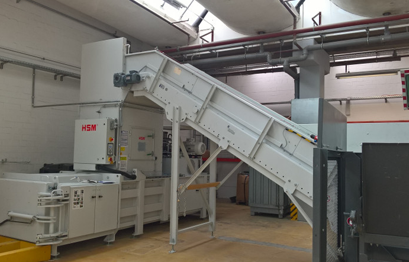
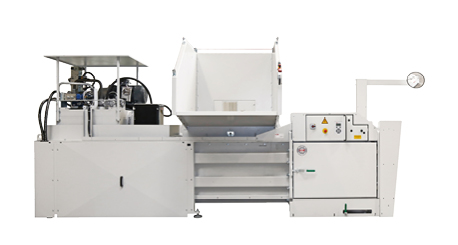
HSM HL 4812
After the company from Heidenheim had a good experience with the vertical baling press from HSM, the way was then open for marketing the much more extensive cardboard material with HSM‘s support. Here too, the customer and HSM designed a solution that deviated from HARTMANN‘s original plans. Additional systems such as a tipping device for a 1.1 cubic meter emptying container as well as a conveyor belt for the feeding were readily agreed on. However, HSM advised the customer not to install a fully automatic baling press, including automatic bale wiring, in Heidenheim. For an obvious reason: the volume of 260 tons per year does not justify a fully automatic system in Heidenheim. Since a staff member would be manually feeding the cardboard waste into the machine, HSM proposed that this person could also manually bind the bales with wire.
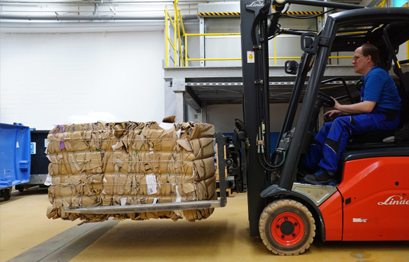
"An almost perfect recycling material loop"
Currently for about three hours a day, an employee is employed in the Homecare Logistics department to press both waste fractions and prepare them for dispatch. HSM advantage: if one machine fails, the other machine can also take over the fraction and compress it. Every six weeks a truck fetches the bales – it can load just under 60 of the 400 kilo packages. The customers for the bales are happy with the new raw material from Heidenheim, reports Michael Kormann: "Correctly sorted, unsoiled, of constant quality and opti- mally compacted – we supply dream bales." It is also ideal that the old cardboard is delivered to the paper factory that produces the cardboard boxes for PAUL HARTMANN AG. This reduces purchasing costs and transport costs – "an almost perfect recycling material loop," says Kormann.
07/2017

 434 kN
 230 kg